An e-book for those who are serious about mastering Python programming on their own
Python knowledge building step by step
from the basics to the first desktop application
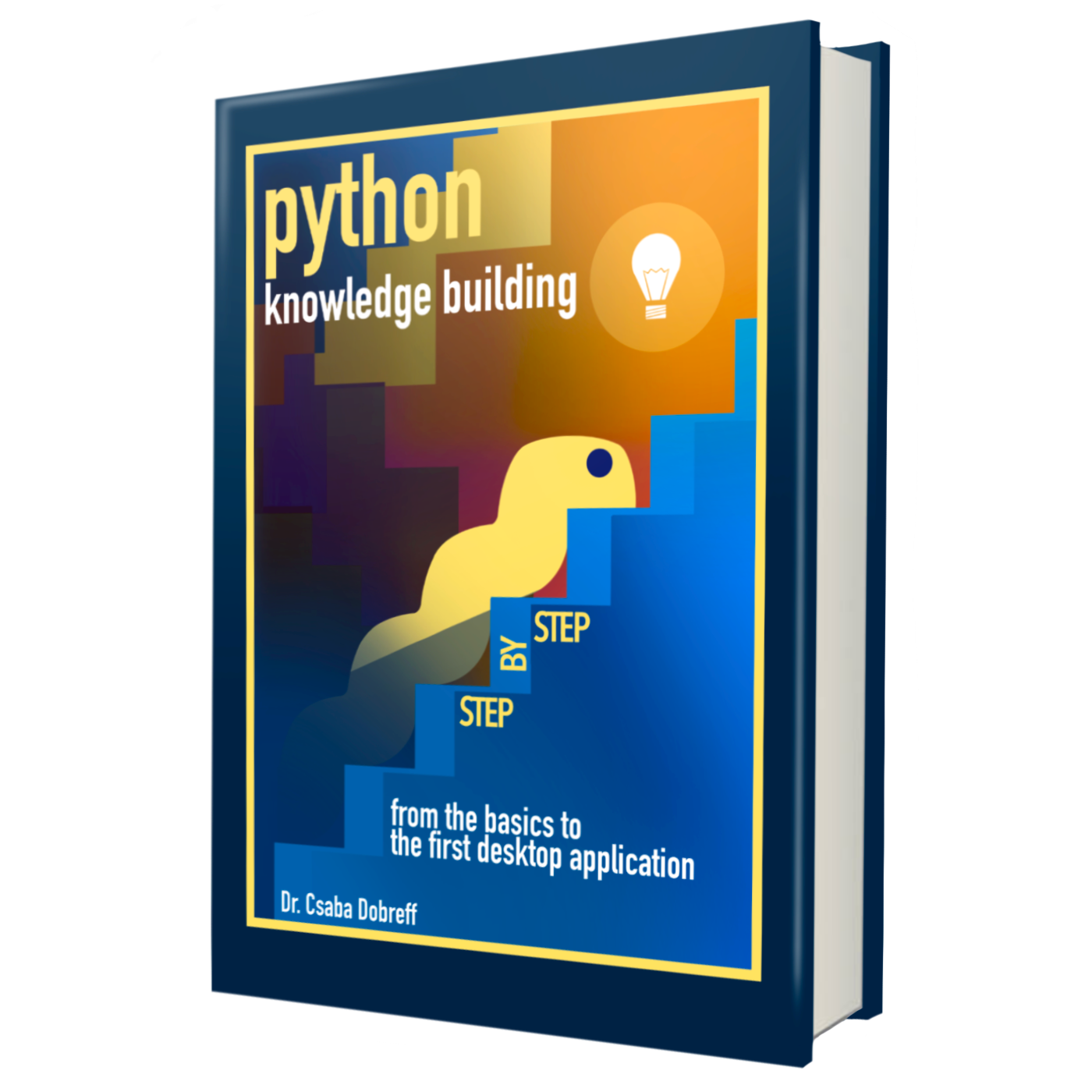
A textbook and language guide in one:
Three books’ worth of material combined into a single volume, built around a clear and
consistent teaching framework.
Purpose of the Book
What can you expect from this e-book?
This book takes you from the essential computer science fundamentals required for Python programming all the way to a practical skill level—one that enables you to independently build fully functional desktop applications, whether console-based or equipped with a graphical user interface.
What can Python be used for?
- web development,
- building desktop applications with console or graphical user interfaces,
- rapid software prototyping to speed up the development process,
- supporting development and operations (DevOps) with automation scripts,
- network programming,
- game development.
Interested in this e-book?
Why Python?
Python is one of the most popular programming languages
- Python is relatively easy to learn, which makes it an ideal first programming language for anyone getting started with coding.
- It is open source and free to use.
- With several decades of evolution behind it, Python has developed a large and active user community — one that supports newcomers and continuously contributes to the language’s growth and improvement.
- Another important advantage is the abundance of high-quality learning materials: countless articles, tutorials, and books—both general and highly specialized—are available to help learners advance.
- Python’s popularity is also driven by its extensive standard library, which offers a rich set of modules right out of the box, as well as by the virtually endless number of external packages and frameworks created by the community. Most of these are free and can be used on their own or easily integrated into programs you develop yourself, supporting a wide range of tasks and domains. Among the most common application areas are:
- data analysis and data science
- artificial intelligence and machine learning
- efficient handling of computational tasks
- powerful tools for data visualization
Who can benefit most from this book?
Instructors and teachers
Students and learners
Software developers

Mérnökök
Engineers

Hobbi programozók
Hobby programmers
Those for whom attending a course would be too expensive

Azoknak, akiknek egy személyes tanfolyami részvétel távolságban és/vagy időben akadályba ütközik
Anyone who cannot participate in in-person training due to distance or scheduling constraints

Frequently Asked Questions (FAQ)
No. The book is only available in electronic format for several reasons.
While a printed book does have the obvious advantage of being readable from the comfort of your armchair, as mentioned in the book’s introduction, effective learning requires active engagement. This means that simply reading the text and code is not enough—you need to sit at a computer, type out the sample programs, test them, and even experiment by making changes. Only through this hands-on practice do the concepts truly stick, and the inevitable mistakes you make become a valuable part of the learning process.
Beyond being a textbook for initial reading, it is also designed as a daily reference manual. Every language element (functions, classes, etc.) is fully documented, so even readers who cannot fully understand the official Python documentation can still access all the necessary information in detail, supported by examples.
In electronic format, searching is much faster and more efficient than in a printed book. This is one of the reasons the entire content was published as a single volume—splitting it into multiple volumes would make searching less effective or awkward in a digital format.
And last but not least, printing a full-color, 1,800-page book—even in large quantities—would be prohibitively expensive and making a printed edition unfeasible.
To protect copyright, the original file cannot be downloaded. The e-book can only be accessed through the methods provided by the distributor’s platform (Google Play). This may include online or offline reading, the latter requiring the appropriate app. For more information, please see the answer to the question: „Can I read the e-book on my mobile phone or tablet?”
Yes, as far as we know, you can read it on your mobile device (tablet/smartphone), even offline, after installing the Google Play Books app. However, please note that the distribution and sales of this e-book are managed solely by Google on its own websites (Google Play and Google Books). This means Google determines on which devices and how this e-book can be read, and this may change. You are therefore advised to check the latest information on Google platforms before making a purchase.
As Google’s sales and distribution platform is independently operated, neither the publisher nor the author is responsible for any aspect of Google’s system or services and cannot provide any advice on its operation or usage. If you have any questions or problems in this regard, please consult the Help sections of these platforms or contact Google directly.
The book serves not only as an introduction to the Python language but also as a reference manual. Every language element (e.g., functions, classes) is described in detail. If questions arise during your programming work about specific language features or their behavior, you can look them up and review them again.
This also makes it easier to understand the official Python documentation, especially when it lacks sufficient detail.
The book focuses on the standard library modules. It provides a detailed explanation of many of these modules, including how to use the functions and classes they offer, generally illustrated with practical examples.
Throughout the compilation of the chapters, a key consideration was that, with very few exceptions (e.g., complex numbers, matrices, Taylor series), the reader should not need any specialized knowledge beyond a mid-level understanding of mathematics and computer science fundamentals to grasp the content.
Consequently, the book does not delve into topics that require further specialization, even at an example level. Such areas include web and network applications, database management, concurrent programming, or even testing — all of which would require entire books on their own.
This focus is reflected in the selection of the standard library modules covered, which include:
abc, array, base64, calendar, cmath, collections, collections.abc, colorsys, contextlib, copy, csv, dataclasses, datetime, decimal, enum, filecmp, fileinput, fnmatch, fractions, functools, importlib, io, itertools, json, locale, math, numbers, operator, os, pathlib, random, secrets, shutil, statistics, string, sys, tempfile, time, timeit, tkinter, tkinter.colorchooser, tkinter.font, tkinter.simpledialog, tkinter.filedialog,tkinter.messagebox, types, typing.
Regarding modules and packages outside the standard library (third-party packages), a few popular ones are mentioned, but their usage is not covered. The only exception is mypy, which is included solely to illustrate static type checking.
There are several reasons why third-party packages are not introduced in detail:
- The primary goal of the book is to provide a very strong foundation in the language itself, which is essential for being able to effectively use external packages and frameworks later on.
- The most popular third-party modules used by many programmers are typically already so complex that each one requires its own dedicated book. This content would simply be too extensive for this book, which is already a significant volume and not a quick read.